
Year-End AP Checklist for QAD: 5 Checks Before Close
Year-end is when small AP problems turn into audit findings, missed discounts and accrual adjustments nobody planned for. Most of them are visible in QAD well before close, if someone looks.
Here are five checks worth running before your team signs off for the year, what to look for in each, and why each one matters now.
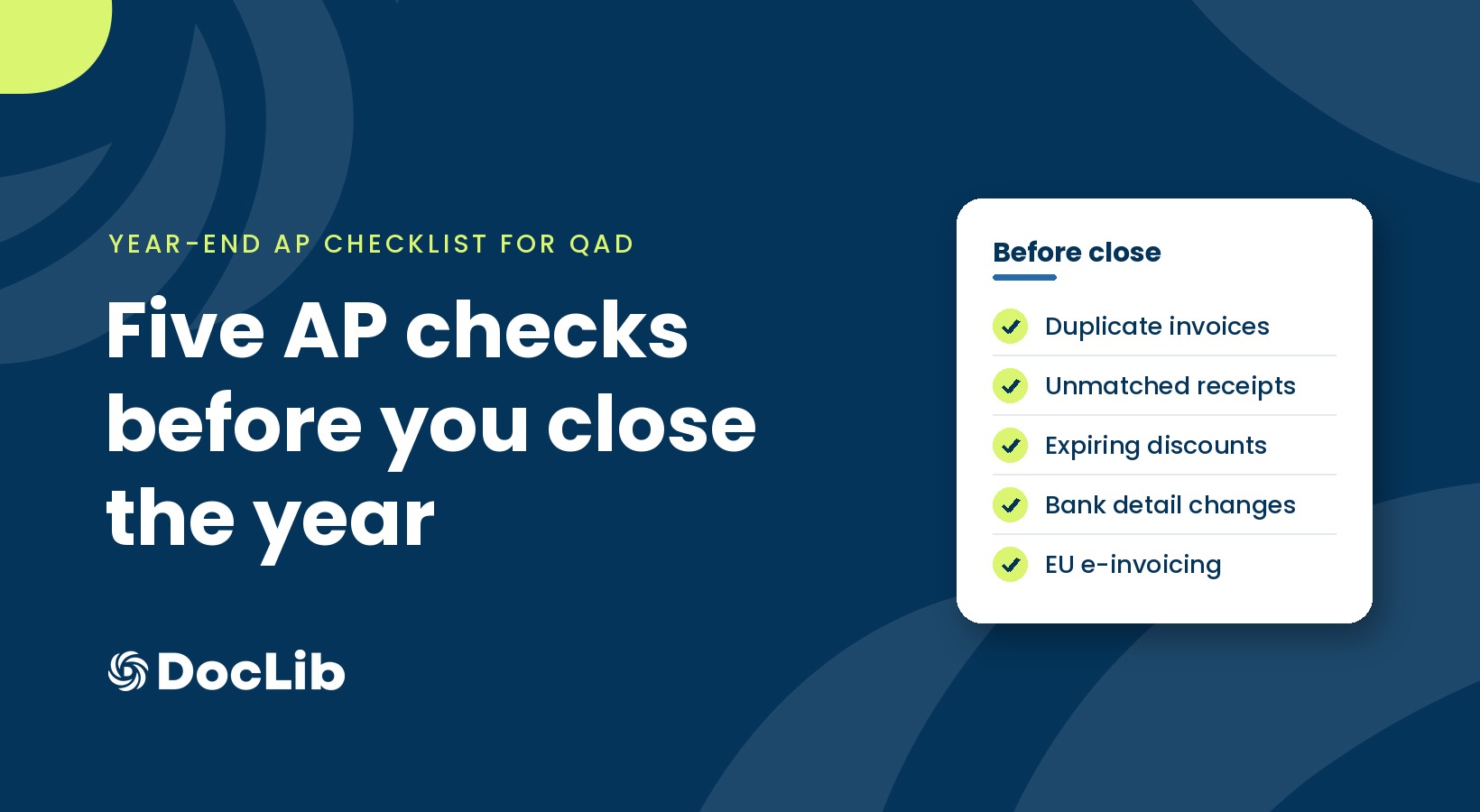
The year-end AP checklist at a glance:
- Look for duplicate invoices waiting for approval
- Clear unmatched receipts and invoices
- List the early-payment discounts due in the next 30 days
- Verify supplier bank detail changes made this year
- Check which EU e-invoicing mandates apply to your entities
1. Look for duplicate invoices waiting for approval
Most teams check for duplicates among posted vouchers. The bigger risk sits earlier. When a supplier resends an invoice because the first copy is still waiting on an approver, the second copy enters the queue looking like a new invoice. If both get approved, both get paid.
What to check:
- Open invoices in your approval queue from the same supplier with matching or near-matching amounts
- Invoice numbers that differ only by a prefix, suffix or a single character, such as INV-1043 and 1043
- Invoices marked “copy” or “reminder” that were entered as new
Why now: suppliers often chase open invoices before their own year-end, so resends tend to rise just as approvers take time off.
2. Clear unmatched receipts and invoices
Receipts with no invoice, and invoices with no receipt, both distort your accruals at close. A receipt with no invoice sits in your goods received not invoiced (GRNI) balance until someone resolves it. An invoice with no receipt sits on hold, and the supplier waits.
What to check:
- Receipts in QAD that have not been vouchered after 60 days. Is the invoice missing, or was the receipt entered wrongly?
- Invoices on hold for a missing receipt. Often the goods arrived and nobody entered the receipt.
- Blanket POs with many receipts and invoices against them, where it is easy to match an invoice to the wrong receipt
Why now: every unmatched item is either an accrual you have to estimate or a liability you have understated. Clearing them before close means fewer manual journal entries and fewer questions from your auditors.
3. List the early-payment discounts due in the next 30 days
Discount terms only pay off if the invoice is approved inside the window. Over the holidays, invoices sit with approvers who are out of the office, and the windows close.
What to check:
- Invoices with discount terms whose discount date falls before mid-January
- Which approvers hold them, and whether they will be out
- Whether any can be approved now or routed to a delegate
Why now: taking a 2% discount for paying 20 days early, as on 2/10 net 30 terms, is worth about 37% a year. A discount that expires over the holidays is savings nobody chose to give up.
4. Verify supplier bank detail changes made this year
Changed bank details are a common starting point for payment fraud. Someone poses as a supplier, emails new bank details, and the next payment run sends the money to them.
What to check:
- Every supplier bank detail change made in QAD this year, and who made it
- Whether each change was confirmed by calling the supplier on a number already on file, not one supplied in the request
- Changes made shortly before a large payment
Why now: payment volumes are high, teams are stretched and people are out. Fraudsters time their requests for exactly that.
5. Check which EU e-invoicing mandates apply to your entities
If you have entities or suppliers in Europe, e-invoicing is no longer a future project. Several countries already require structured e-invoices between businesses, and more deadlines arrive in the next 12 months:
- Belgium: structured B2B e-invoices have been mandatory since January 1, 2026.
- Poland: the national KSeF system became mandatory on February 1, 2026 for the largest businesses and on April 1, 2026 for all other VAT-registered businesses. Micro-businesses join on January 1, 2027, which is also when penalties for KSeF errors begin.
- France: since September 1, 2026, every business must be able to receive e-invoices, and large and mid-sized companies must issue them. Small and medium-sized businesses must issue them from September 1, 2027.
- Germany: every business has had to be able to receive e-invoices since January 1, 2025. From January 1, 2027, businesses with prior-year turnover above €800,000 must issue them, and all businesses must issue them from January 1, 2028.
These invoices carry their data as structured XML rather than as a document to read. A scanning process built for PDFs cannot read them, so AP needs a way to receive, validate and post them.
What to check: which of your entities and suppliers fall under each mandate, and when. Our e-invoicing readiness guide asks seven questions about your European entities and shows which deadlines apply in about two minutes. You also get an AP action plan and a supplier notice you can send this week.
Make the first three checks part of every invoice
The first three checks are year-end jobs only because they are manual. DocLib automates accounts payable inside QAD, in real time, so they happen on every invoice as it arrives:
- Duplicates are stopped, whether the invoice is already booked in QAD or still waiting in an approval workflow.
- PO invoices are matched against the live PO and receipt in QAD, and the packing slip number can be used to tie each invoice to the right receipt on busy blanket POs. Clean matches post as vouchers without anyone keying them.
- Exceptions go to the right approver, and reporting on supplier discount terms shows which discounts are coming due.
There is no middleware and no separate system of record. DocLib works with every QAD version.
Watch an invoice go from inbox to a voucher in QAD, or run your own numbers in the ROI calculator.
Frequently asked questions
What should AP check before year-end close?
At a minimum: duplicate invoices waiting for approval, unmatched receipts and invoices, early-payment discounts due over the holidays, supplier bank detail changes made during the year, and any e-invoicing mandates that apply to your entities.
When does e-invoicing become mandatory in Germany?
Every business in Germany has had to be able to receive e-invoices since January 1, 2025. Businesses with prior-year turnover above €800,000 must issue them from January 1, 2027, and all businesses from January 1, 2028.
Can AP automation catch duplicate invoices before they are paid?
Yes, if it checks invoices that are still in approval as well as those already posted. Many duplicates are created while the first copy is waiting on an approver. DocLib checks both against QAD before a voucher is created.
See it in your QAD setup
If any of these checks takes your team more than an afternoon, it is worth seeing how DocLib handles them on every invoice. Book a demo and we will walk through it using your QAD version and your approval rules.
Published on November 18, 2026
Last Updated on November 18, 2026
Ready to transform your AP automation?

AP Automation, built for complex finance teams. Streamline invoice processing, approvals, and reporting in real time — designed to align with your ERP environment.
Continue reading

Why AP Delays Aren’t Just About Volume (And Where Time Actually Gets Lost)
The DocLib Team • 2 mins read

Improving Supplier Collaboration in AP Automation as Invoice Volume Grows
The DocLib Team • 3 mins read

AP Automation for Manufacturers: Why Real-Time ERP Integration Makes or Breaks It
The DocLib Team • 5 mins read