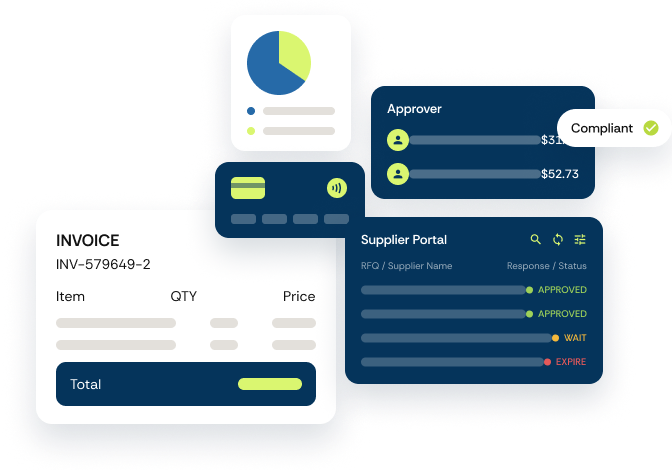
AP Automation Software Comparison
Real-time AP Automation, built to work natively with QAD
Most AP automation software processes invoices in its own platform and posts the finished result to your ERP afterward.
For manufacturers running QAD, that gap between the AP tool and the system of record creates real work: duplicate records, stale views, reconciliation nobody signed up for.
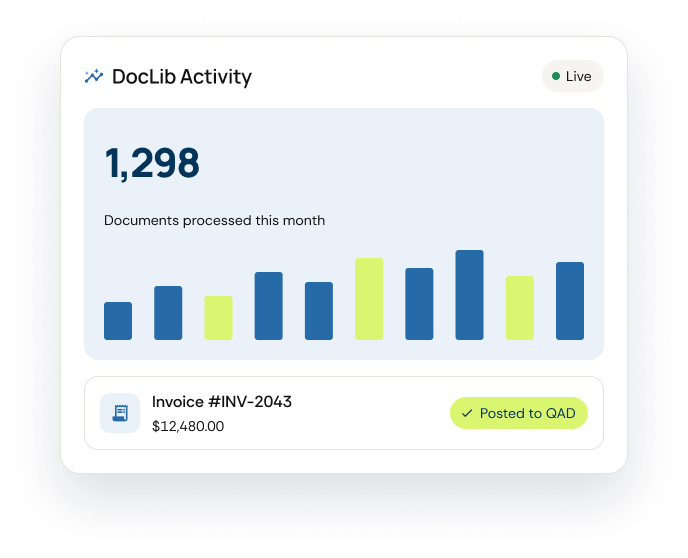
DocLib takes a different approach, built specifically for AP automation in manufacturing: it creates the voucher inside QAD in real time, so your system of record is never out of sync.

QAD-native AP automation, built for manufacturers
Don't settle for AP that sits
beside your ERP

Where does AP data live and get validated during processing?
In the cloud. Validated data transfers to QAD afterward.

Inside QAD, in real time. QAD stays the single record of truth.

When does QAD reflect the invoice?
After it finishes processing, once the validated result syncs back.
As it happens. The voucher is created in QAD in real time.

Do approvals auto-escalate when they stall?
Workflow routing by rule; escalation depth varies by configuration.
Yes — by entity, amount, or time.

Is AP Automation a focus?
One module in a broad S2P + O2C suite.
Yes; focused AP, built for QAD manufacturers.

How long has the vendor worked in the QAD ecosystem?
Relatively recent entrant.
30+ years in the QAD ecosystem, with every version since MFG/PRO.
PROVEN RESULTS
Numbers that hold up inside QAD


75 - 85%
Typical touchless invoice processing

15 min
Avg. review, down from 1–3 weeks
One system. Two clear wins.

Finance Teams
Cash and payables live in QAD in real time, not last night's batch figure. Model ROI on your own invoice volume before you sign, with fewer errors, duplicate payments, and missed early-payment discounts.

IT and ERP managers
Native to every QAD version from MFG/PRO to Adaptive. No second system of record to reconcile at close.

Frequently asked questions
It depends on what your evaluation weighs most: for manufacturers running QAD or NetSuite specifically, the deciding factor is usually whether the software processes invoices inside your ERP in real time or in a separate platform that syncs afterward. Doclib does the former; most AP automation software, including Esker, does the latter.
Most AP automation software integrates through a connector: it imports ERP data, processes invoices in its own platform, and posts the result back. Doclib integrates differently — it's native to QAD, so the voucher is created inside your ERP as the invoice moves, with no separate system to reconcile.
Doclib is built specifically for QAD, while Esker is a general AP automation platform that connects to QAD through an integration layer. If your AP team runs on QAD, Doclib posts vouchers directly inside QAD in real time instead of syncing from a separate system.
Esker processes invoices in its own cloud platform and transfers validated data to your ERP afterward. Doclib works inside QAD as each invoice moves, so QAD reflects the current status without a separate sync step.
Doclib runs inside QAD using QAD's own supported software. QAD stays your single system of record — nothing is replicated into a separate platform to reconcile later.
DocLib is native to every QAD version, from MFG/PRO to Adaptive, and to NetSuite out of the box. Other ERPs can also be supported.
DocLib typically follows a 9–12 week implementation timeline: kickoff and workflow mapping, ERP integration (Weeks 2–5), finance rollout and training (Weeks 6–8), and go-live with ongoing support (Weeks 9–12). After launch, teams continue optimizing processes to maximize automation.
Doclib is built for complex manufacturing AP — PO matching with tolerances, blanket POs, and auto-GL — so it's best suited to QAD manufacturers with real invoice volume, not light-usage back offices.
See it work with your QAD environment
A 30-minute walkthrough — your workflow, your numbers. You'll know whether it fits before the call is over.